
Australia is facing a mounting skills shortage: according to Jobs and Skills Australia, 36 % of occupations assessed in 2023 (332 out of 916) were in national shortage. Jobs and Skills Australia To combat this, the Australian Government has re‑oriented migration policy to focus heavily on filling workforce gaps via skilled migration and skills‑assessment pathways. VisaVerge+2HECT Migration & Appeal Experts+2
In this context, organisations such as ACTS Visa Skills play a meaningful role — by assessing overseas tradespeople and aligning their skills with Australian standards, they act as a bridge between international talent and Australia’s labour market needs. This blog explores the nature of the shortfall, the role of ACTS Visa Skills, how they contribute to addressing the crisis, and what the opportunities and challenges are.
The Skills Shortage Picture in Australia
What’s going on?
- Many sectors report acute shortage of workers: trades, construction, health care, aged care, IT and cybersecurity. For example, the building and construction industry has raised alarm about the shortfall of skilled tradespeople such as engineers, mechanics, painters and tilers
- According to Jobs and Skills Australia: “Skills shortages remain elevated … 36% of occupations assessed were in national shortage in 2023.” Jobs and Skills Australia
- The existence of the national Skilled Occupation List (SOL) and its variants reflects this: the government publishes lists of occupations in demand so that immigration policy can target these. Immigration and citizenship Website+1
Why does it matter?
- Skills shortages slow economic growth: if key roles aren’t filled, projects get delayed, productivity drops and costs rise. For example, the construction sector warns that without enough “tradies”, housing supply is under pressure. The Guardian
- Regional and sectoral imbalances: Some areas of Australia (especially regional) struggle disproportionately
- Migration and labour policy hinge on skills supply: the government is pushing for migration intake that better matches “skills in demand”. VisaVerge+1
The Role of ACTS Visa Skills
Who are we?
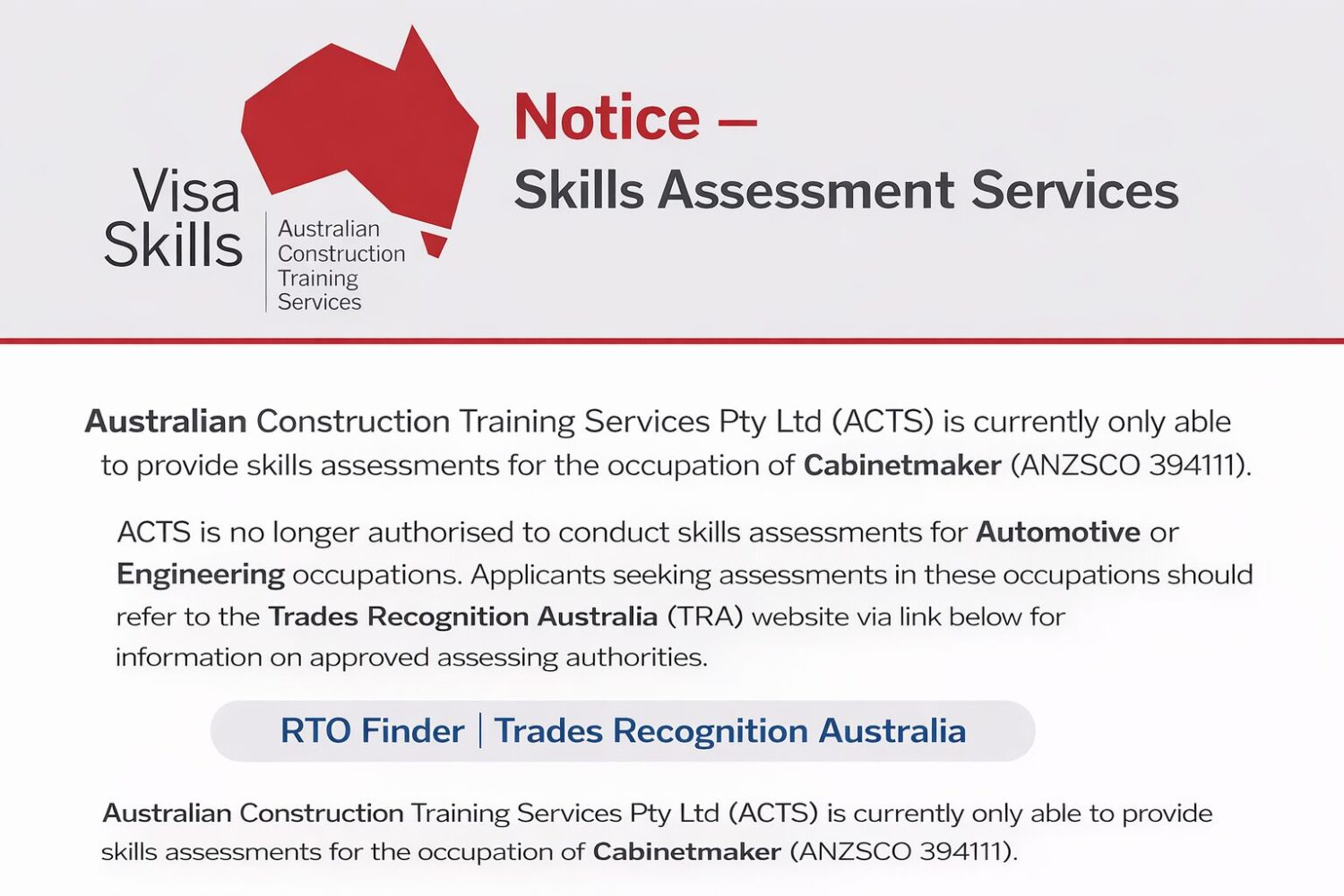
Australian Construction Training Services (ACTS) is a Registered Training Organisation (RTO) endorsed by Trades Recognition Australia (TRA) to conduct skills assessments of trade workers, especially for migration and recognition purposes. We specialise in trade‑occupations (for example mechanics, metal fabricators, welders, plant mechanics) and provide assessment pathways under the TRA Offshore Skills Assessment (OSAP) and TSS programs.
What do we do and why is it relevant?
- Skills assessment: We assess overseas qualified or experienced tradespeople to check whether their skills match Australian standards or can be converted. This is often a prerequisite for visa applications or employment in Australia
- Bridging supply and demand: By providing a recognised “green‑light” for overseas tradespeople to enter Australia’s workforce, this helps fill critical trades roles (a gap identified in the shortage lists)
- Supporting migration pathways: As Australia refocuses migration on “skills in demand”, the ability to have a trade‑skills assessment becomes increasingly a key part of the migration and work‑entry pipeline
Why this matters for the skills shortage
- Faster matching of talent: Through assessments, overseas workers can be more quickly validated to work in Australian roles, reducing friction in the supply chain of labour
- Quality and standardisation: Ensuring that the skills of incoming workers meet Australian requirements mitigates risks such as mismatch, under‑qualification, or integration issues
- Supporting trades sectors: Given that many of the shortage occupations are trade‑type (e.g., construction trades, mechanics) — the services that we provide are directly relevant to filling those gaps
- Regional and industry impact: Skilled migration via trade assessments can be especially helpful for industry sectors or regional locations where local workforce supply is weak
Opportunities and Benefits
- For employers: Access to a broader international pool of qualified tradespeople, with the assurance that skills have been assessed and validated
- For migrants/tradespeople: More clarity and pathway into Australia; chance to convert overseas experience into Australian credentials; better employment opportunities
- For Australia more broadly: By utilising validated trade skills from overseas, the country can alleviate bottlenecks, enhance productivity, and support growth in sectors suffering shortage
Challenges and Considerations
While the role of ACTS Visa Skills is important, there are some caveats:
- Visa / immigration policy complexity: The broader migration environment is evolving. For instance, the old Temporary Skill Shortage (TSS) visa was replaced by the new Skills in Demand (SID) visa (subclass 482) from December 2024, which has different streams, salary thresholds and occupation‑list structures. Mullins Lawyers | Advisors | Partners+1
- Matching of trades to demand: Some trades remain excluded or subject to consultation for inclusion in the core skills occupation list. For example, key building trades were reportedly being “left out” of fast‑track lists. The Australian
- Recognition and integration: Skills assessment is only the first step — actual employment, licensing, adjustment to Australian working conditions, culture & regulation can still present hurdles
- Processing delays: Some parts of the system (visa processing, labour‑market testing) are seen as slower than anticipated which can hamper timely supply. The Australian
- Local workforce concerns: There is debate (including by unions) about the extent of shortage and whether overseas workers might undercut local workers or reduce incentives to train more Australians. News.com.au
Future Outlook
Given current trends, the role of trade‑skills assessment providers like ACTS Visa Skills will remain vital. Some key things to watch:
- Evolving occupation lists: The government’s Core Skills Occupation List (CSOL) and similar lists will continue to change in response to labour‑market data. Trades that are currently excluded may become eligible
- Regional focus: As Australia emphasises regional growth and decentralisation, the demand for trades in non‑metro areas may intensify — and overseas skilled tradespeople may help fill those gaps
- Policy and permanent residency pathways: As visa policy shifts (e.g., SID visa streams, clearer permanent residency routes), the attractiveness of trade migration may increase — meaning more reliance on skills‑assessment frameworks
- Training and upskilling of local workforce: Simultaneously, Australia will need to continue investing in domestic training and apprenticeships so that local labour market issues are resolved sustainably
Conclusion
Australia’s skills shortage is real and significant. In that context, organisations like ours – ACTS Visa Skills play a pivotal role by helping to validate and integrate overseas trade talent into Australia’s workforce. While we are not a silver bullet (policy, local training, and labour‑market conditions still matter), we play a key part of the ecosystem that allows Australia to respond more flexibly and effectively to labour‐supply shortfalls. For tradespeople overseas, for employers in Australia with shortage roles, and for policymakers, the alignment of skills assessments with migration policy and labour‑market needs offers a promising route — provided the process is timely, equitable and matched to real demand.